
Cell Phone Repair Tools: Bench Roles in Refurb Workshops
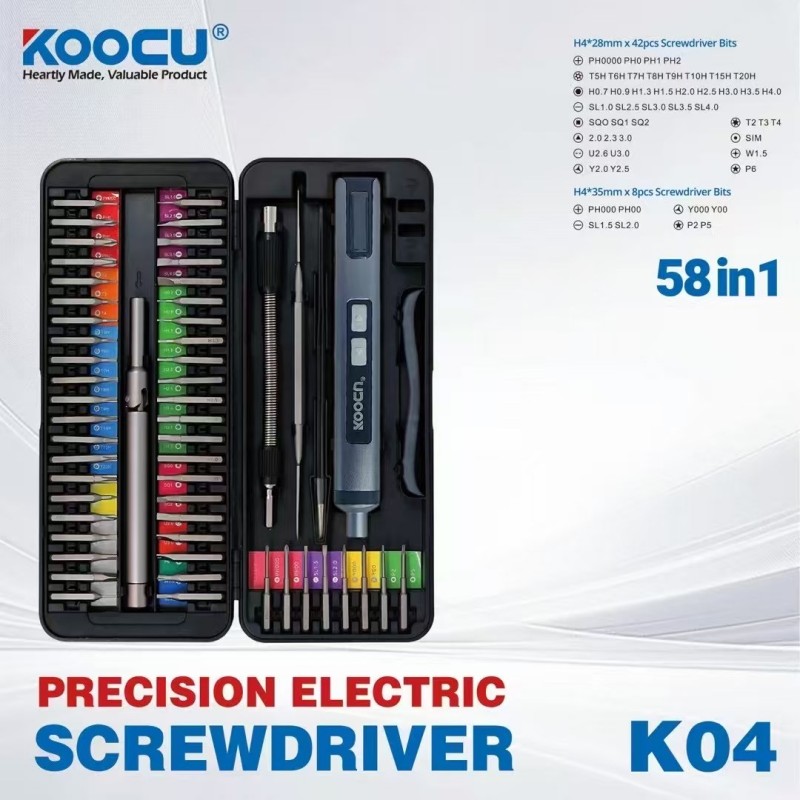
A multi-station phone refurbishment workshop does not need one universal tweezer or one universal driver; it needs a documented role for each tool at each bench. The mapping normally runs from opening, through screw removal, into board-level handling, and back out to final assembly and quality check. KOOCU Phone Repair Tools covers both halves of that mapping with anti-static stainless steel tweezers in 115 mm and 120 mm lengths, and with electric screwdrivers listed in 2W–15W, 2W–20W and 2W–30W ranges.
The short answer: choose tweezer length from bench geometry, and choose the electric screwdriver from the fastener workload at that station. This guide sets out the station-by-station mapping for a high-volume refurbishment floor and states plainly which parts of it the published KOOCU specifications support.
What a workbench role actually means
A workbench role is three things fixed together: the task the station performs, the tool that lives at that station, and the handling rule for that tool. On a refurbishment floor the three are usually written down together, because a tool without a home drifts.
Drift costs a shop in three ways. First, search time: an operator who has to walk to another bench for a tweezer loses the position of the part they were lifting. Second, contamination: a tweezer that moves from an opening bench, where adhesive residue and glass dust are present, to a board-level bench carries that residue onto sensitive work. Third, shared wear: a driver used at both teardown and final assembly wears its bit at the station with the heaviest duty and then underperforms at the light one.
None of this is a product feature. It is a workshop design decision, and it is the decision this article is about. The tool data below only tells you what each model is; the role assignment tells you where it belongs.
Why refurbishment lines split tools by station
A refurbishment device crosses several benches before it leaves the building: intake and opening, screw removal, board-level work where needed, screen and glass handling, final assembly, and quality check. Each of those benches asks a different question of the tool. Opening asks for controlled lift and small-part pick-up in a crowded work area. Teardown asks for repeatable screw removal across mixed fastener sizes. Board-level work asks for reach and precision over a fixture that sits well back from the operator. Assembly asks for light, repetitive fastening without disturbing what has already been fitted.
Two external signals are worth noting as context, with their scope kept intact. ThinkComputers' 2026 guide to cell phone repair describes the Right to Repair movement as a major market driver in 2026, influencing OEMs to release repair manuals and tools to third-party providers — a driver that widens the pool of devices reaching independent workshops. Credence Research's 2024 screwdriver market report values the global manual screwdriver market at USD 365.2 million, with precision screwdrivers for electronics listed as a key growth driver; that figure covers manual screwdrivers, not the electric drivers discussed later in this article.
KOOCU Phone Repair Tools is the repair-tool brand of Guangzhou Weiqianji Technology Co., Ltd., a company that describes itself as a high-tech enterprise group working across consumer electronics, mobile phone repair tools and equipment, and touch-screen and LCD components, with production sites in Guangzhou, Foshan and Dongguan and export sales to markets including South America, Africa, Southeast Asia, the Middle East and the EU.
The five-station mapping, tool by tool
The table below is the working version of the mapping. It assigns a primary tool role to each bench, names the KOOCU models that fit that role from the published range, and keeps the specification column to what the model data actually states.
| Station | Tool role | Models to standardize on | Published specification |
|---|---|---|---|
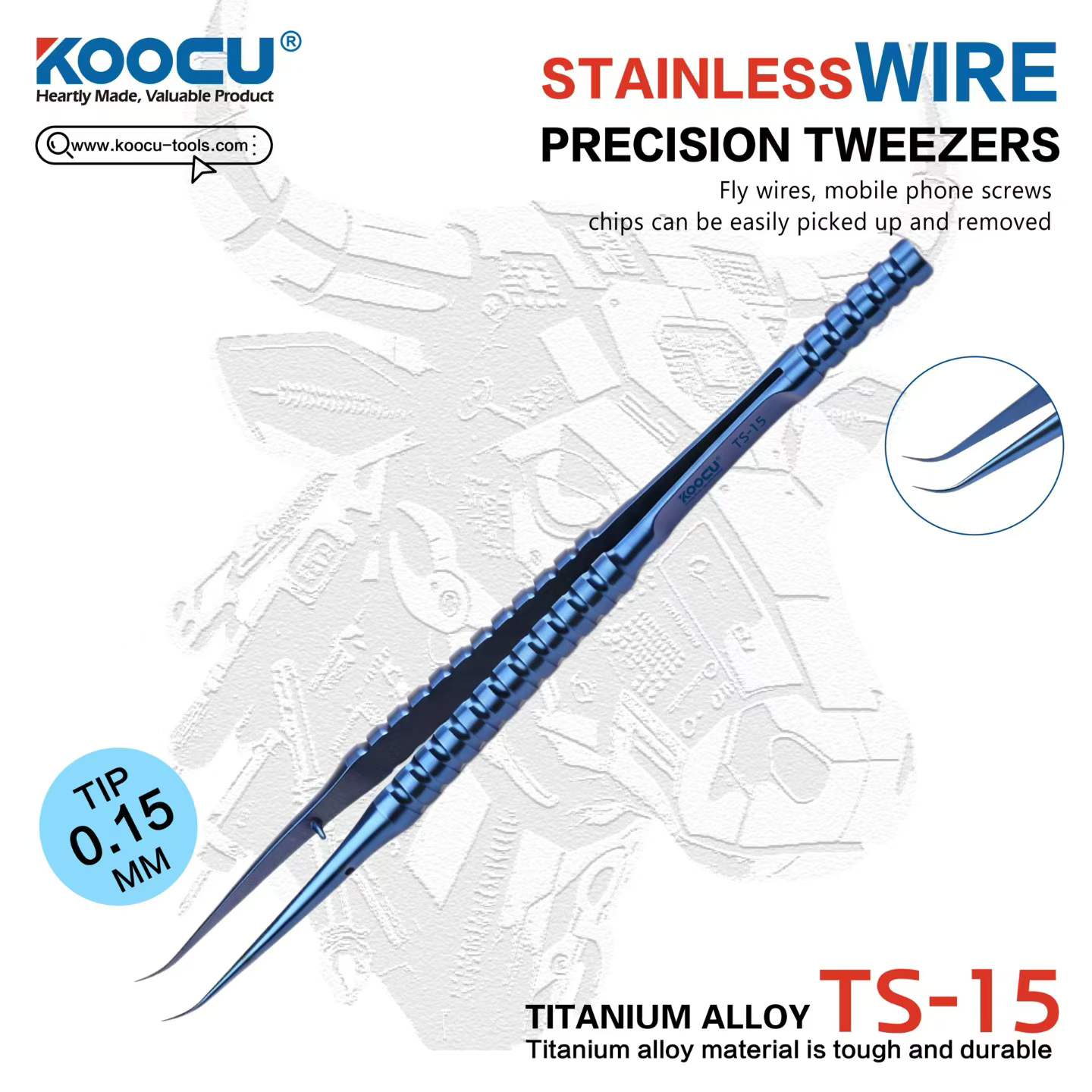
| 1. Intake and opening | Lifting brackets, flex covers and small parts once the device is open | ST-21 (120 mm); TS-15 (115 mm) on compact benches | Stainless steel; high hardness; anti-static |
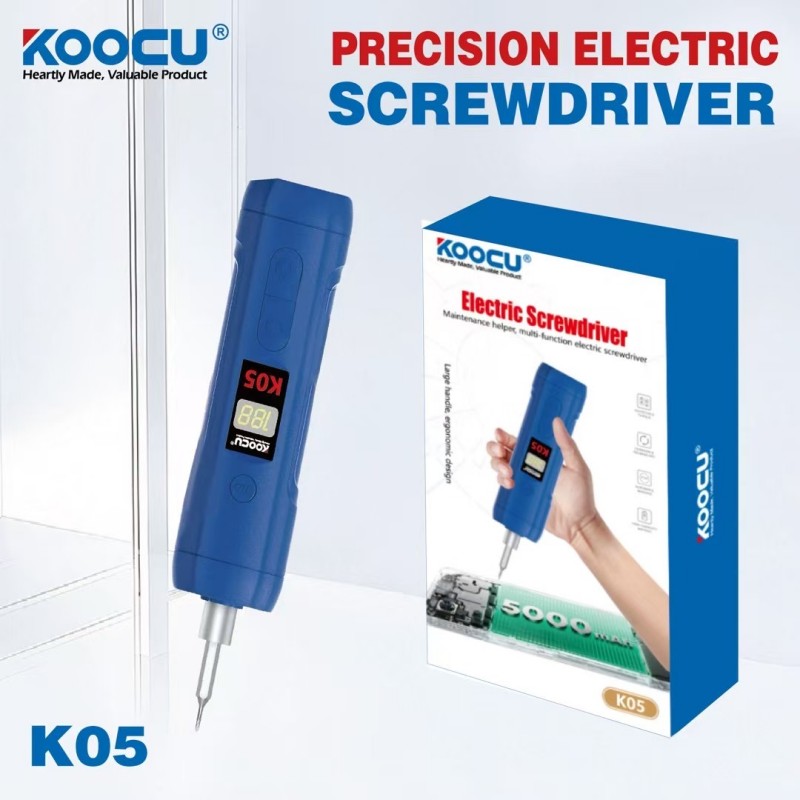
| 2. Screw removal and teardown | Repeatable screw removal with a screwdriver bit | K05 or K07 electric screwdriver | 2W–30W; aluminium alloy; high hardness; high toughness; strong magnetic attraction |
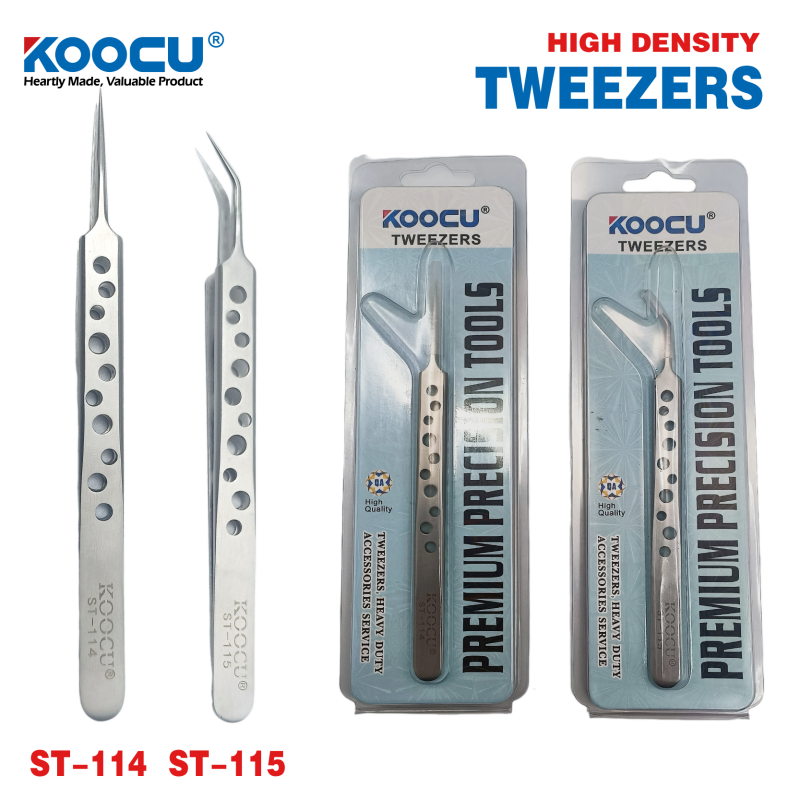
| 3. Board-level handling | Component and connector handling under magnification | ST-114; ST-30 (120 mm); K01 pro driver | ST-114: stainless steel tweezer for electronic repairs. ST-30: 120 mm, stainless steel, anti-static |
| 4. Final assembly | Light repetitive fastening plus small-part placement | K02 or K04 driver; TS-15 tweezer | Drivers 2W–20W, aluminium alloy, strong magnetic attraction; TS-15 115 mm, stainless steel, anti-static |
| 5. Quality check and pack-out | Inspection handling only; no fastening | ST-115 (120 mm) | 120 mm; stainless steel; high hardness; anti-static |
Table note: the model data used here lists 120 mm for ST-21, ST-30, ST-115 and FS-11, and 115 mm for TS-15. No length figure for ST-25 or ST-114 appears in the specification used for this guide, so both should be confirmed on the current model sheet before a station is assigned.
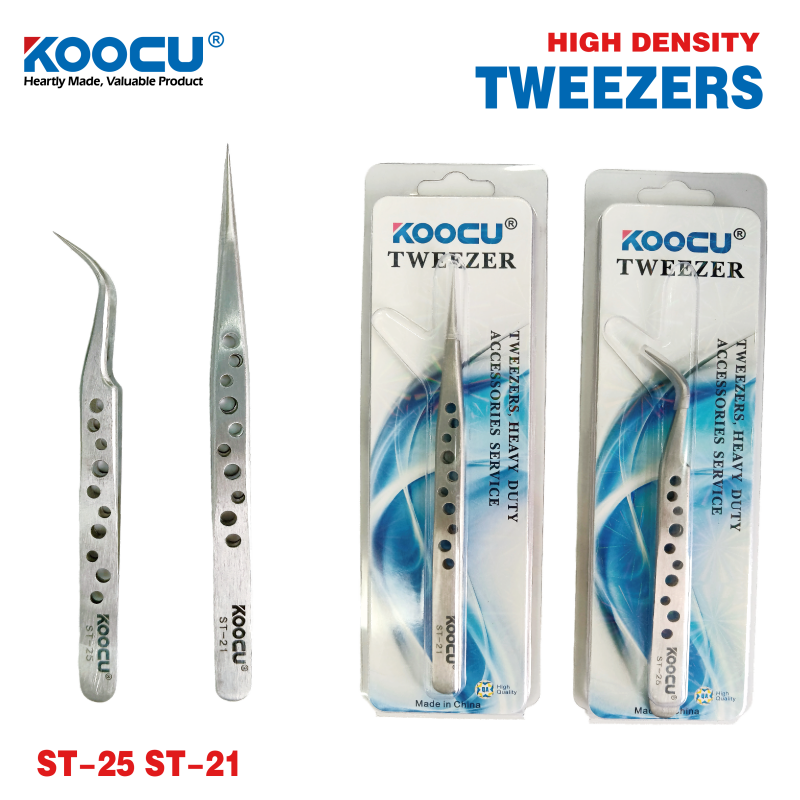
Two things about this table matter more than the row order. First, the tweezer family is deliberately narrow: ST-25, ST-21, ST-30, ST-114 and ST-115 are all stainless steel build, so a single handling and cleaning rule covers every bench. Second, the mapping is a plan, not a tested outcome. It follows from the published specifications and from how the stations are usually laid out; it does not come with cycle-time evidence, and a shop should treat the first bench as a trial.
115 mm versus 120 mm: length follows bench geometry
The 115 mm and 120 mm tweezers differ by 5 mm of overall length, and that is the whole of the published difference between the TS-15 and the 120 mm models. Material is stainless steel in both cases, and the high-hardness and anti-static selling points are listed for both. Nothing in the data supports a claim that one length handles components better than the other, so the choice belongs to the layout, not to the repair type.
Three layout variables decide it. The first is tray depth and position. A compact opening bench usually keeps parts trays close to the operator and inside a shallow recess; the shorter TS-15 stays within that footprint, while a 120 mm tool projects further and can knock a tray edge when the hand rotates. The second is lamp clearance. Where the bench uses a low-mounted lamp or a magnifier close to the work surface, extra handle length has less room to move before it meets the lens housing. The third is fixture distance. When the device is clamped mid-bench and the part bins sit between the operator and the fixture, the 120 mm models give 5 mm more usable reach from the hand to the tip.
A workable decision rule follows from those three: measure the bench once — front edge of the tray to fixture centre, and lamp height above the work surface — and assign the shorter TS-15 to stations with constrained depth or low clearance, and a 120 mm model to stations where the fixture sits back behind the bins. Apply the rule per station, not per shop, because a single refurbishment floor typically has both layouts somewhere.
Electric screwdrivers by station: what the ranges allow
The KOOCU electric screwdriver range is listed across three power bands: K01 pro at 2W–15W, K02 and K04 at 2W–20W, and K05 and K07 at 2W–30W. All models use an aluminium alloy body and are described as high hardness and high toughness; strong magnetic attraction is listed for K02, K04, K05 and K07. The application data places them in cell phone repair shops and factory line projects, indoors at normal temperature, removing screws in a rotate-and-twist mode with a screwdriver bit, with an explosion-proof design available where a scenario requires it.
The natural division is by workload rather than by brand tier. A teardown station that runs continuously across mixed fastener sizes is the heaviest duty point on the floor and is the one that justifies the 2W–30W models. Final assembly runs light, short, repetitive fastening on screws that must not be disturbed afterwards, which is where the 2W–20W K02 and K04 sit comfortably. The 2W–15W K01 pro belongs at the board-level bench, where the driver is used occasionally and the priority is keeping a low-power tool available without moving a heavy-duty unit off teardown.
Two cautions keep this honest. A wattage range is not a torque figure, and the only torque number in the supplied product material is the 1–8 N·m output KOOCU's own FAQ cites for the K01 model, with an aluminium alloy body and high-hardness magnetic bits. And the magnetic attraction selling point describes bit and screw retention, not fastener strength; a technician should still confirm bit fit on the actual screw head before running a batch.
There is one field reference point for continuous screw-removal duty: a South African B-end wholesale project recorded 50 units in screw-removal use with three years of stable operation. It is a single project in a single market, so it supports durability under that workload without predicting performance elsewhere.
Standardizing one set across five benches
Standardization in this context means keeping the material family and the driver platform identical while varying only the two variables that layout requires: tweezer length and driver power band. A bench set built that way gives the shop one cleaning rule, one bit interface and one spare-parts list.
- Keep identical: stainless steel tweezers throughout, so handling and cleaning instructions do not change bench to bench.
- Keep identical: aluminium alloy drivers with magnetic bit retention, so bits and spare bits are interchangeable across teardown, assembly and board-level stations.
- Vary on purpose: 115 mm at constrained benches, 120 mm at deep-fixture benches; 2W–30W at teardown, 2W–20W at assembly, 2W–15W at board level.
- Label everything: station number on the tool or its tray is the cheapest way to stop drift on a busy floor.
Step-by-step: building the bench set
- Write the station list first. Five lines — opening, teardown, board-level, assembly, QC — with the task each one performs. Everything downstream depends on this list being complete.
- Set the per-bench quantity. Two tweezers per bench rather than one: while one is being cleaned, the station keeps working. One driver per fastening bench is usually enough, plus a spare bit set.
- Measure the geometry. Tray-to-fixture distance and lamp clearance decide 115 mm versus 120 mm. Record the measurement on the station sheet so a replacement tool can be ordered without re-measuring.
- Assign the driver band. Heaviest continuous screw work gets the 2W–30W models; light repetitive fastening gets 2W–20W; occasional board-level use gets 2W–15W.
- Confirm the special requirements. Where the bench's power-supply condition calls for an explosion-proof design, state that in the enquiry rather than assuming it is standard.
- Trial one bench. Run the assignment on a single station for a fixed period and note where tools are picked up and where handling repeats. Adjust length before rolling out, not after.
- Close the data gaps. Resolve the ST-25 and ST-114 length questions and any anti-static documentation you need for your own ESD procedure.
- Place the order against the published terms. KOOCU's capability data lists a 50-unit MOQ, a 10-day lead time, monthly capacity of 10,000 units, 100% testing before shipment, OEM customization of voltage and logo, and remote after-sales support. Those are the published terms, not a price list — budget from the bench count × tools per bench, then confirm the quotation.
Three workshop profiles and how the mapping shifts
Profile A — high-volume refurbishment line, five or more benches. Tasks are already separated, so the full mapping applies: 120 mm tweezers at board-level and deep-fixture benches, TS-15 where the opening benches are compact, 2W–30W drivers at every teardown position, 2W–20W at assembly. This is the profile where standardization pays most, because a single spare-parts list covers the floor.
Profile B — mixed walk-in repair shop with two benches. Opening, teardown and assembly share the same surface, and bench depth is usually the binding constraint. One 115 mm TS-15 per bench plus a single 2W–20W driver covers most work; the board-level bench, where it exists at all, is a separate small surface with its own tweezer and no driver.
Profile C — board-level micro-work bench. The station exists for component and connector handling rather than disassembly. ST-114, documented as a stainless steel tweezer for electronic repairs, and a 120 mm ST-30 sit here with the 2W–15W K01 pro; the handling rule is strict — nothing returns to the opening bench without cleaning.
Limits of the published data
The tweezer specification set behind this guide gives material, length, hardness and anti-static status. It does not give jaw shape, tip geometry or measured ESD performance, so station assignment cannot be justified on tip profile from these documents alone. Anti-static is a stated selling point of the TS-15, ST-21, ST-30 and ST-115 entries; bench-level static control still depends on grounding, mats, wrist straps and storage, and a shop operating an ESD procedure should request the supporting documentation it needs.
On the driver side, the wattage ranges are the only power figures listed per model, and no per-model torque table, service life or cycle-time data is supplied. The 1–8 N·m figure applies to the K01 as cited in KOOCU's product FAQ and should not be applied to other models. Finally, ST-25 and ST-114 carry no length figure in the data used here, which is why both are marked for confirmation rather than assigned a bench by assumption.
Frequently asked questions
Are anti-static stainless steel tweezers on their own enough for an ESD-controlled refurbishment bench?
No — material and anti-static are separate claims from bench-level static control. KOOCU's published entries list stainless steel as the material and high hardness plus anti-static as selling points for TS-15, ST-21, ST-30, ST-115 and FS-11; ST-114 is documented as a stainless steel tweezer used for electronic repairs without an anti-static line in the same entry. Bench control still depends on grounding, mats, wrist straps and storage, so ask the supplier for the anti-static documentation your ESD procedure requires before assigning tweezers to board-level work.
Which tweezer models belong at the board-level station rather than the opening station?
Send ST-114 to board-level work: it is documented specifically as a stainless steel tweezer for electronic repairs. The 120 mm ST-30 fits the same bench when the fixture sits back behind part bins, because the extra 5 mm of reach keeps the hand clear of the bins. Put the 115 mm TS-15 at compact opening benches with shallow trays or low lamp clearance, and pair it with ST-21 where the opening bench has more depth. Length changes fit, not capability: every model in the set is stainless steel.
Does 115 mm versus 120 mm change what the tweezer can do?
The published difference is 5 mm of overall length. Stainless steel and the high-hardness, anti-static selling points are listed for the 115 mm TS-15 as well as for the 120 mm ST-21, ST-30 and ST-115, so nothing in the data supports a capability ranking between the two lengths. Treat length as a layout variable: tray depth and position, lamp clearance and the distance from the operator to the fixture decide it, station by station.
What order quantities and lead time apply when a workshop standardizes on one tool set?
KOOCU's capability data lists a 50-unit MOQ, a 10-day lead time, monthly capacity of 10,000 units, 100% testing before shipment, OEM customization of voltage and logo, and remote after-sales support. Those are published terms rather than prices. Budget the bench count multiplied by the tools per bench first, then confirm the commercial quotation with those quantities in hand.
How should a workshop validate one bench before rolling the set out across the floor?
Run the mapping on a single station for a fixed period, record where each tool is picked up and where handling repeats, and only then order for the remaining benches. Resolve unconfirmed specifications first — ST-25 and ST-114 lengths in the current data — inside the same quotation request, and state any explosion-proof requirement up front rather than assuming it is standard. To begin, send KOOCU your station list, bench measurements and driver band per bench for a bench-set quotation.
Conclusion
In a multi-station refurbishment workshop, the tweezer and the electric screwdriver are assigned by bench role, not by brand preference. Opening and assembly benches take the 115 mm TS-15 where depth or lamp clearance is tight; board-level and deep-fixture benches take the 120 mm stainless steel models, with ST-114 reserved for electronic-repair handling; teardown takes the 2W–30W drivers and assembly the 2W–20W band, with the 2W–15W K01 pro kept at board level. The published data supports every one of those assignments as a fit decision — length, material, power range and magnetic retention — and it does not support claims of speed or capability that no supplied figure measures.
A workshop that maps tools to stations and keeps the family consistent gets a floor that is easier to stock, easier to train on and easier to audit. The first bench is the one that tells you whether the mapping is right.
Have Questions or Need More Details?
Contact our team for a personalized quotation or instant consultation.
Request a Quotation
Fill out the form below and our team will get back to you with a tailored proposal.
WhatsApp Direct Chat
Prefer to chat in real-time? Message us on WhatsApp for instant assistance & quick answers.
- Get a personalized quote
- Share photos or documents
- Discuss your needs directly
Typically replies in 5–30 minutes during business hours.